
Metabolic
Ayurvedic Treatment for Fatty Liver

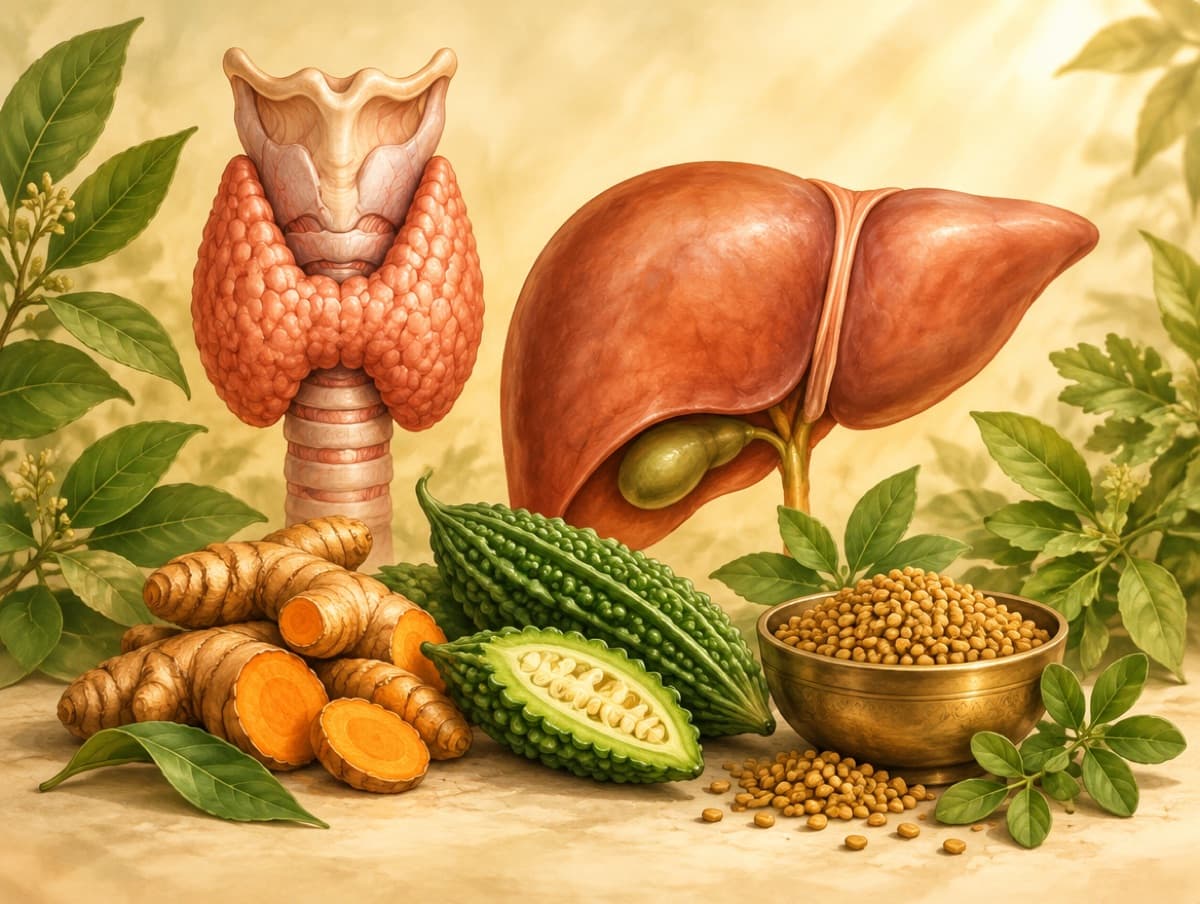
Ayurveda treats fatty liver as Kapha and Meda (fat tissue) accumulating in the liver (Yakrit) because Agni is weak and intake exceeds what the body can process. Dr. Bali corrects diet and routine first, then prescribes formulations built around Bhumyamalaki, Punarnava, Kutki and, in-clinic, Arogyavardhini Vati, with liver enzymes and ultrasound tracked at fixed intervals.
01
Who this page is for
- Grade one or two fatty liver found on an ultrasound, often by chance, with or without raised liver enzymes.
- Fatty liver alongside weight gain, prediabetes, type 2 diabetes or high triglycerides.
- Persistent heaviness, bloating or discomfort under the right ribs after meals.
- Fatty liver in a slim person, which points to eating pattern and Agni rather than weight alone.
- A wish to act before fatty liver progresses to inflammation or scarring.
02
How Dr. Bali approaches fatty liver
The classical texts have no chapter on fatty liver; the condition was named by ultrasound, not by pulse. What they do describe is the liver (Yakrit) as a seat of Pitta and Rakta, and Medoroga, the disorder of fat tissue, in which Kapha and Meda accumulate because Agni is too weak to process what is eaten and the channels that should carry nutrition become blocked. Fatty liver is that process, seen in one organ.
Dr. Bali reads fatty liver as a Kapha-Meda disorder with a Pitta element in the liver itself. The typical patient eats late, eats heavy, sleeps after lunch and has a sluggish bowel; some are slim but skip meals and live on refined carbohydrate. He looks at your ultrasound grade, liver enzymes, lipids and sugars, then at Agni, Prakriti and routine, before setting the plan. Diet does most of the work; formulations support it.
Classical reference · Medoroga (Yakrit)
Charaka describes how excess Meda blocks the body's channels so that the other tissues go unnourished while fat keeps building, and names the causes: overeating, heavy and sweet food, lack of exercise, day sleep and inactivity. His treatment is reduction: food that is heavy in bulk but low in nourishment, such as barley, together with exercise, staying awake and formulations that scrape Meda. The chapter on abdominal disorders covers enlargement of the liver and spleen, treated with bitter, Pitta-clearing formulations.
Charaka Samhita, Sutra Sthana, chapter 21 (Ashtauninditiya) on Medoroga and Chikitsa Sthana, chapter 13 (Udara Chikitsa) on disorders of the liver and spleen; Madhava Nidana (Medoroga Nidana)
What the assessment looks at
- Ultrasound grade, liver enzymes (ALT, AST, GGT), lipids, fasting sugar or HbA1c, and any fibrosis score your doctor has done.
- Alcohol, medication and supplements, since some raise enzymes and change the picture.
- Eating pattern: meal timing, portion, refined carbohydrate, sweets, fried food, day sleep and late dinners.
- Agni, bowel habit and any acidity, which Ayurveda links directly to the liver.
- Weight distribution, activity and your Prakriti, which set the Kapha-Meda reading.
When to see a doctor locally first
Yellowing of the eyes or skin, dark urine with pale stool, severe pain under the right ribs, vomiting blood, black stool, a swollen abdomen, confusion or drowsiness, or raised enzymes with heavy alcohol use need a local doctor or hepatologist first. Fatty liver with a raised fibrosis score, or any sign of cirrhosis, should be under a specialist before Ayurvedic treatment is added. Dr. Bali will ask about these first.
03
What treatment may include
- 01
Diet for the liver
A written plan built on light, freshly cooked, bitter and astringent food, barley and millets, controlled portions, no day sleep and an early dinner. Sweets, fried and reheated food, alcohol and late meals are reduced. Set to your Prakriti and household.
- 02
Liver-clearing formulations
Classical preparations built around Bhumyamalaki (Phyllanthus niruri), Punarnava, Kutki and Guduchi, chosen for your pattern and dispensed with a certificate of analysis. Arogyavardhini Vati is used for in-clinic patients under supervision, with enzymes monitored.
- 03
Correcting Agni and bowel habit
Mild formulations such as Triphala where the bowel is sluggish, and attention to acidity and bloating, since a congested gut keeps the liver loaded.
- 04
Exercise and routine
Daily walking or exercise matched to your capacity, and correction of day sleep and late nights, which Charaka lists among the causes of Medoroga.
- 05
Panchakarma where indicated
Udvartana (herbal powder massage) for Kapha-Meda and, in selected patients with good strength, a supervised Virechana in Chandigarh. Most grade one cases do not need it.
- 06
Monitoring and follow-up
A review at six to eight weeks, liver enzymes at three months and a repeat ultrasound at six months where your doctor agrees. Online patients are followed by video with formulations shipped to them.
The combination is set after assessment, not before. Dr. Bali does not recommend the same protocol for every patient with the same diagnosis.
04
Formulations, shipping and the law
Formulations Dr. Bali prescribes are dispensed in India and shipped to patients abroad by tracked courier, typically within 7 to 14 days. Each parcel carries an itemised invoice, an ingredient declaration and the batch certificate of analysis. Patients in India receive them by courier within 2 to 4 days, or collect them at the Chandigarh clinic.
- Every batch is tested by an independent laboratory for identity, heavy metals, pesticides and microbial contamination. The certificate ships with the parcel and is emailed to you.
- Mineral-based classical preparations (Bhasma) are not shipped internationally. Dr. Bali prescribes plant-based formulations for patients abroad.
- Shipments stay within a three-month supply so they clear customs as personal-use supplements. Country-specific rules are on each country page.
- In-clinic procedures such as Basti, Ksharasutra and full Panchakarma are given in Chandigarh; the assessment, diet and formulations can be managed by video.
- Consultation fees are confirmed at booking. Formulation costs are quoted before anything is dispensed.
Dr. Bali is licensed to practise Ayurveda in India. For patients abroad, an online consultation is an Ayurvedic assessment with guidance on diet, routine and classical formulations; it does not replace your local doctor, and prescribed medication is never stopped without the prescriber's agreement.
05
Frequently asked questions
Can fatty liver be treated with Ayurveda?
Yes, particularly at grade one and two. The liver stores fat when intake exceeds what Agni can process, and both sides of that are treatable: diet, routine and exercise on one side, liver-clearing formulations on the other. Progress is checked on enzymes and ultrasound rather than assumed.
How long does Ayurvedic treatment for fatty liver take?
Heaviness, bloating and energy usually improve within four to six weeks. Liver enzymes are rechecked at three months and the ultrasound at six, which is when grade changes are usually seen. Grade two and three, and cases with diabetes, take longer. The diet continues after formulations are reduced, or the fat returns.
Which Ayurvedic medicine is best for fatty liver?
No single one. Bhumyamalaki, Punarnava, Kutki and Guduchi are the common plant bases, and Arogyavardhini Vati is used in-clinic under supervision. The combination depends on your enzymes, Dosha pattern and other conditions, and is prescribed after assessment, not bought over the counter.
Can I consult for fatty liver online from the USA, Canada or the UK?
Yes. Dr. Bali reviews your ultrasound and blood reports by video, prescribes diet and formulations that are shipped to you with customs documentation and a certificate of analysis, and asks you to repeat enzymes locally at three months. Mineral-based preparations such as Arogyavardhini Vati are not shipped abroad; plant-based formulations are prescribed instead.
Is fatty liver serious?
Grade one fatty liver is common and, with diet, often settles fully. Left alone with the same habits, a proportion progresses to inflammation and scarring over years, which is why it is worth acting on now rather than watching. A raised fibrosis score needs a hepatologist alongside.
Can fatty liver be treated without weight loss?
Slim people get fatty liver too, from skipped meals, refined carbohydrate, late eating and weak Agni. For them the plan is about timing and quality of food, not calories. For overweight patients, steady weight loss through the same diet and routine is part of the treatment, without crash dieting, which itself loads the liver.
Does fatty liver cause acidity and bloating?
Often the two run together, because the same weak Agni and heavy, late eating produce both. Ayurveda treats them as one pattern, and patients frequently find that the acidity settles as the liver plan takes hold. Persistent acidity is also assessed in its own right.
What does treatment cost?
Consultation fees are confirmed when you book and depend on the consultation type. Formulation costs depend on the plan and are quoted before anything is dispensed, so there are no surprises after the consultation.

Written and reviewed by
Dr. Arvinder Singh Bali, BAMS
22+ years of clinical practice · 3,00,000+ patients · Government Ayurvedic College, Punjab
Dr. Arvinder Singh Bali is a BAMS qualified classical Ayurvedic physician with over 22 years of clinical practice in Chandigarh, Punjab, India, who has treated 3,00,000+ patients and provides online Ayurvedic consultations through Calmvida to patients in the USA, Canada, UK, Australia, UAE, Russia and Uzbekistan.
Last updated 3 September 2026
Consult Dr. Bali about fatty liver.
In-clinic in Chandigarh or by secure video from anywhere. Bring your reports and a note of what you have already tried.