
Skin & hair
Ayurvedic Treatment for Hair Loss and Hair Fall

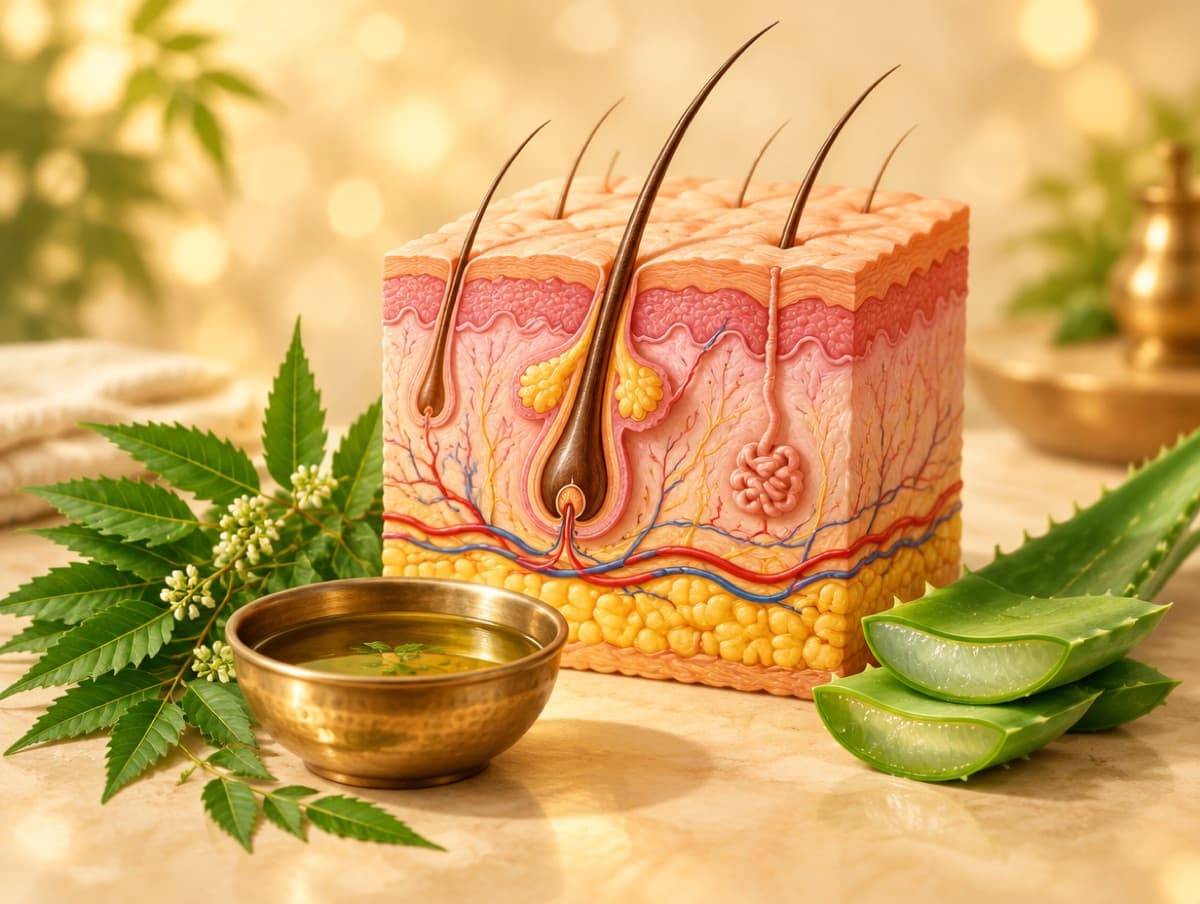
Ayurveda treats hair loss (Khalitya) by finding what is driving it, since hair fall is usually a sign of something upstream: heat in the scalp, poor nutrition of tissue, thyroid or iron problems, hormonal imbalance or stress. Dr. Bali assesses these before prescribing formulations built around Bhringaraj and Amalaki, scalp oils, Nasya and a diet that feeds the hair root.
01
Who this page is for
- Hair fall of more than a few months that has not responded to shampoos, serums or supplements.
- Thinning at the crown or temples, or a widening parting, in men or women.
- Round bald patches diagnosed as alopecia areata, which Ayurveda calls Indralupta.
- Hair loss after illness, childbirth, a thyroid diagnosis or a period of heavy stress.
- Premature greying alongside hair fall, or a scalp that is itchy, flaky or oily.
02
How Dr. Bali approaches hair loss
Ayurveda calls diffuse hair loss Khalitya and patchy loss Indralupta. Both are read as disorders of the scalp tissue and the Doshas that reach it, not as a problem of the hair strand. Sushruta describes Pitta and Vata heating and drying the hair root so the hair falls, with Kapha and Rakta then blocking the follicle so nothing regrows. Hair is also treated as a by-product of bone tissue (Asthi), so poor tissue nutrition shows in the hair early.
Dr. Bali does not treat hair loss without a cause. He asks about thyroid function, iron and vitamin D levels, PCOS or other hormonal patterns, recent illness, medication and stress, and requests blood tests where they are missing. Only then does he set the Dosha reading: Pitta-type loss with heat, early greying and a sensitive scalp; Vata-type with dry, brittle hair and a dry scalp; Kapha-type with an oily scalp and dandruff.
Classical reference · Khalitya
Sushruta lists Khalitya and Indralupta among the minor diseases (Kshudra Roga). Pitta with Vata dries the hair root at the scalp so the hair falls; Kapha and Rakta then block the follicle and prevent regrowth. Treatment is cleansing (Shodhana) where needed, blood-letting in selected cases, and then repeated application of medicated oils and pastes to the scalp, with Nasya. Vagbhata, in the daily-routine chapter, states that regular oiling of the head prevents headache, hair fall and premature greying.
Sushruta Samhita, Nidana Sthana (Kshudra Roga Nidana) and Chikitsa Sthana (Kshudra Roga Chikitsa); Ashtanga Hridaya, Sutra Sthana, chapter 2 (Dinacharya) and Uttara Tantra (Shiroroga chapters)
What the assessment looks at
- Pattern of the loss: diffuse thinning, receding temples, a widening parting or round patches.
- Thyroid, iron, ferritin, vitamin D and, in women, PCOS or other hormonal signs. He will ask for recent tests or request them.
- Scalp condition: dryness, oiliness, flaking, itching or heat.
- Diet, sleep, stress, recent illness, childbirth and medication, including hair products.
- Dosha pattern of the loss and your underlying Prakriti.
When to see a doctor locally first
Sudden hair loss in handfuls, bald patches that appear within days, hair loss with a scaly, painful or scarred scalp, loss of eyebrow or body hair, or hair fall with unexplained weight change, fatigue or missed periods need a local doctor and blood tests first. Scarring alopecia and some autoimmune conditions need a dermatologist's diagnosis before any Ayurvedic treatment. Dr. Bali will ask about these first.
03
What treatment may include
- 01
Finding and treating the driver
Where thyroid, iron, PCOS or stress is behind the hair fall, that is treated first or alongside, because oil on the scalp cannot fix a low ferritin.
- 02
Internal formulations
Classical preparations built around Bhringaraj, Amalaki and Guduchi, with nourishing (Brimhana) formulations where the tissue is depleted, chosen for your Dosha pattern and dispensed with a certificate of analysis.
- 03
Medicated scalp oils
A prescribed oil for regular scalp application, selected for a hot, dry or oily scalp, with instructions on how and how often, since technique matters as much as the oil.
- 04
Nasya
Medicated nasal drops, the classical route for disorders above the collarbone. Home Nasya is taught for online patients; the intensive form is given in Chandigarh.
- 05
Diet and routine
Protein and iron-rich foods suited to your digestion, correction of late nights and skipped meals, and reduction of heat-producing foods where the scalp runs hot.
- 06
Follow-up
A review at six to eight weeks, then every two to three months. Hair grows slowly, so photographs at fixed intervals are used to track change. Online patients are followed by video with formulations shipped to them.
The combination is set after assessment, not before. Dr. Bali does not recommend the same protocol for every patient with the same diagnosis.
04
Formulations, shipping and the law
Formulations Dr. Bali prescribes are dispensed in India and shipped to patients abroad by tracked courier, typically within 7 to 14 days. Each parcel carries an itemised invoice, an ingredient declaration and the batch certificate of analysis. Patients in India receive them by courier within 2 to 4 days, or collect them at the Chandigarh clinic.
- Every batch is tested by an independent laboratory for identity, heavy metals, pesticides and microbial contamination. The certificate ships with the parcel and is emailed to you.
- Mineral-based classical preparations (Bhasma) are not shipped internationally. Dr. Bali prescribes plant-based formulations for patients abroad.
- Shipments stay within a three-month supply so they clear customs as personal-use supplements. Country-specific rules are on each country page.
- In-clinic procedures such as Basti, Ksharasutra and full Panchakarma are given in Chandigarh; the assessment, diet and formulations can be managed by video.
- Consultation fees are confirmed at booking. Formulation costs are quoted before anything is dispensed.
Dr. Bali is licensed to practise Ayurveda in India. For patients abroad, an online consultation is an Ayurvedic assessment with guidance on diet, routine and classical formulations; it does not replace your local doctor, and prescribed medication is never stopped without the prescriber's agreement.
05
Frequently asked questions
Can Ayurveda regrow hair?
Where the follicle is still alive, as in most diffuse thinning and in alopecia areata, regrowth is possible once the driver is treated and the scalp is cared for. Where the follicle has scarred over, no system regrows it, and Dr. Bali will say so after examination rather than promise otherwise.
How long does Ayurvedic treatment for hair loss take?
Hair fall usually slows within six to eight weeks of treatment. Visible regrowth takes longer because of the hair cycle: three to six months before new growth shows, and longer for density. Where thyroid or iron is the cause, the timeline follows the correction of those.
Which Ayurvedic oil is best for hair fall?
There is no single best oil. Bhringaraj-based oils suit a hot scalp with early greying; heavier nourishing oils suit dry, brittle hair; lighter oils with drying herbs suit an oily, flaky scalp. Using the wrong oil can make things worse, which is why the oil is prescribed after assessment.
Can I consult for hair loss online from the USA, Canada or the UK?
Yes. Dr. Bali assesses the scalp by camera and photographs, reviews your blood tests, and prescribes formulations and oils that are shipped to you with customs documentation and a certificate of analysis. Home Nasya can be taught by video. If tests are missing, he will tell you which to ask your local doctor for.
Does Ayurveda treat alopecia areata?
Alopecia areata is Indralupta in the classical texts and is treated with internal formulations, scalp applications and attention to stress and digestion. Many patches regrow. Rapidly spreading or total loss should be assessed by a dermatologist alongside, and Dr. Bali will say if your case needs that.
Is my hair loss caused by thyroid or PCOS?
It may be, which is why Dr. Bali asks for thyroid function, iron and, in women, hormonal tests before treating. Hair fall with weight change, fatigue, irregular periods or facial hair growth points to one of these, and treating the hair alone would waste your time.
Will hair loss come back after Ayurvedic treatment?
Hair fall recurs when the driver returns: stress, poor diet, an untreated thyroid. Keeping the routine, oiling and diet that worked is part of the plan, and a short course of formulations is sometimes repeated at seasonal change.
What does treatment cost?
Consultation fees are confirmed when you book and depend on the consultation type. Formulation costs depend on the plan and are quoted before anything is dispensed, so there are no surprises after the consultation.

Written and reviewed by
Dr. Arvinder Singh Bali, BAMS
22+ years of clinical practice · 3,00,000+ patients · Government Ayurvedic College, Punjab
Dr. Arvinder Singh Bali is a BAMS qualified classical Ayurvedic physician with over 22 years of clinical practice in Chandigarh, Punjab, India, who has treated 3,00,000+ patients and provides online Ayurvedic consultations through Calmvida to patients in the USA, Canada, UK, Australia, UAE, Russia and Uzbekistan.
Last updated 3 September 2026
Consult Dr. Bali about hair loss.
In-clinic in Chandigarh or by secure video from anywhere. Bring your reports and a note of what you have already tried.